In a move that will make Xbox One avatars significantly more inclusive for gamers, Microsoft is planning to make wheelchair options available.
The news was confirmed by Xbox head Phil Spencer, who stepped into a conversation between two Twitter users discussing the possibility of creating a petition to bring in a wheelchair option for avatars, stating “no petition needed, we hear you. This is something we’ve already looked at, not far off.”
Shortly after this, Xbox engineering lead Mike Ybarra tweeted a “sneak peek” of the coming update which showed two Xbox avatars in wheelchairs that were not-so-subtly Xbox-themed. It’s also been noted that the avatars depicted in Ybarra’s sneak peek appear to be visually improved with more detailed faces, leading fans to wonder if there’s a more significant upgrade to be announced.
It wasn’t stated when the updated avatars will be made available but the next major Xbox One and PC update called Anniversary is coming in early August so there’s perhaps a chance we’ll hear more about these improvements then. Planning to include this avatar option is a positive move on the part of Microsoft that will make an important contribution towards improving gamer representation on the Xbox platform.
Kenyan entrepreneur, Anzazi Kiti managed to generate roughly $1,600 a month by starting a pretty successful spices business with only $48.
Kiti, who started the the business Taste Afrique a company that produces natural spice mixes under the brand Chibundiro. Kiti also holds a full time job as an accountant with the audit firm Ernt & Young.
In an interview with CNBC Africa, Kiti said “We realized that there was a problem of people using artificial seasoning. So we came up with an idea where by we were going into healthy living and advocate for people to use natural food season. So we decided to make Chubindiro,”
Kiti relies heavily on word of mouth and social media to establish her brand into a market that is dominated by household brands from larger companies.
Taste Afrique was recently awarded a prize of $2000 by a regional competition ”
Youth For Agribusiness”. This capital boost, Kiti says, will be used to mechanise some of the production processes so that she and her team can pack more cans per day.
Kiti has big ambitions for Taste Afrique as she been observing regional markets in Uganda, Rwanda and Tanzana and once she is done with all the regulations and requirements she could start exporting to the U.S and Europe.
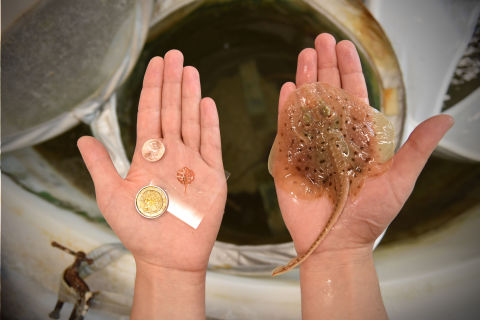
This soft robotic stingray is made of rat heart muscle. Yeah, it's just as crazy as it sounds.
"Roughly speaking, we made this thing with a pinch of rat cardiac cells, a pinch of breast implant, and a pinch of gold. That pretty much sums it up, except for the genetic engineering," says Kit Parker, the bio-engineer at Harvard who led the team that developed the strange robot.
"I THINK WE'VE GOT A BIOLOGICAL LIFE-FORM HERE."
GIF
Upon optical stimulation, the tissue-engineered ray propelled by producing forward thrust via the undulatory motion of its fins.
Sung-Jin Park
Parker's robotic stingray is tiny—a bit more than half an inch long—and weighs only 10 grams. But it glides through liquid with the very same undulating motion used by fish like real stingrays and skates. The robot is powered by the contraction of 200,000 genetically engineered rat heart-muscle cells grown on the underside of the bot. Even stranger, Parker's team developed the robot to follow bright pulses of light, allowing it to smoothly twist and turn through an obstacle courses. The fascinating robot was unveiled today in the journal Science.
"By using living cells they were able to build this robot in a way that you just couldn't replicate with any other material," says Adam Feinberg, a roboticist at Carnegie Mellon University who has worked with Parker's team before, but was not involved in developing this new robot. "You shine a light, and it triggers the muscles to swim. You couldn't replicate this movement with on-board electronics and actuators while keeping it lightweight and maneuverable. And it really is remote controlled, like a TV set."
HOW TO BUILD A LIVING BOT
To understand just how muscles from a rat can power a robot stingray, let's dissect this bad boy layer by layer. The stingray bot is composed of four sequential layers of material. The top layer is a 3D body of a silicone material—"the same thing as the outer coating of a breast implant," says Parker—that's been cast in a titanium mold. This flexible, bendy body holds the other materials together.
The second layer down is a simple gold skeleton. "The skeleton's there because we needed some recoil, so that the pectoral fins bounce back to their original positions" once they're done undulating, Parker says. Why gold? The team found the material had just the right stiffness and flexibility to bend and bounce, "and it's really easy to work with," he says.
The third layer down is another hyper-thin layer of silicone. This prevents the heart muscle from having direct contact with the gold, but also plays another huge role. Along with that top 3D layer, the silicone is cast with just the right small-scale patterns so that the next layer, the rat cells, "grow with the exact muscular architecture we want," says Parker. "With the right geometric design, we can guide these cells to form the tissue we want."
Lastly, the underside of the robot is layered with living rat cells. These cells have been genetically engineered, and are originally from the heart muscles. Parker layers them on each of the robot stingray's two fins in a serpentine, back-and-forth pattern. These cells send along a signal for other cells down the line, creating a switchback cascade of flexing muscle that pulls the fins in the exact undulating motion of a real stingray.
Karaghen Hudson and Michael Rosnach
Here's where the genetic engineering fits in. The robo-stingray's muscles will start to contract only when flashed by a specific wavelength of bright light. This is done through a genetic engineering technique called optogenetics, which allows otherwise normal cells to respond to light. To guide his stingray, Parker merely has it follow a flashing, two-pronged light source. When the lights flash, the bot starts undulating. To have the stingray bank and turn, Parker need only flash one side of the stingray with a brighter, or more rapidly flashing light. Both will cause fins to stroke faster or more powerfully.
The bot can swim in a liquid that has suspended nutrients in it to keep the rat heart cells fed and alive. Even after 6 weeks, the stingray bot was still swimming with over 80 percent of its cells still alive and well. "But there are definitely challenges that need to be overcome," says Feinberg. Even with the right nutrients you wouldn't be able to swim this bot outside of a lab, because the cells are basically defenseless to infection. "They don't have an immune system, so it's not protected from bacteria or fungus," Feinberg says.
"WE MADE THIS THING WITH A PINCH OF RAT CARDIAC CELLS, A PINCH OF BREAST IMPLANT, AND A PINCH OF
More than 30,000 Syrian children are facing starvation in Jordan after authorities in Amman suspended life-saving food and medical aid to refugees living along its northeastern border with Syria.
Between 60,000-70,000 Syrians, mostly women and children, have been denied access to food and safe drinking water during the Islamic holy month of Ramadan, a period of fasting from dusk till dawn, after Jordanian authorities blocked emergency aid supplies to an area known as the "berm" last month following an attack by members of the Islamic State of Iraq and the Levant (ISIL, also known as ISIS) group.
Shortly after the attack, Jordan declared the porous border area, which houses the sprawling Rukban refugee camp, a "closed military zone", and warned that any movement in the area would be treated "without leniency", despite pleas by aid and humanitarian groups that this would put the lives of refugees at risk.
At a time of year when temperatures can exceed 35C, Al Jazeera has learned that harsh conditions in the camp have forced some Syrians to head back to Syria.
"We're getting terrible stories of people deciding to go back into Syria because of the appalling conditions they are facing in this desolate and remote desert area," Gerry Simpson, a senior refugee researcher and advocate at Human Rights Watch, told Al Jazeera on Friday.
"What these people need right now is water and food ... Jordan has blocked all food and medical aid to these people - over half of whom are children. Jordan has allowed a limited amount of water, but that is nowhere near enough."
I am a Syrian Child - Al Jazeera World
The medical aid charity Doctors Without Borders called the situation a "massive failure of the international community" and warned of increasing cases of malnutrition.
Of the 1,300 children under five years old in the area that it screened for malnutrition, 204 were suffering from moderate malnutrition and 10 were severely malnourished.
It also said that 24.7 percent of the children seen by medical teams had acute diarrhoea.
There are an estimated 650,000 Syrian refugees registered by the United Nations in Jordan, and the country's northern border is the only access point through which they can enter the country.
"Jordan isn't the only country that is treating Syrian refugees this way," Simpson said. "Turkey has closed its border for a year and half now, and shoots at asylum seekers as they try and cross. Lebanon has severely restricted access and so Syrians aren't able to escape there either.
"Jordan, Lebanon and Turkey are all trapping Syrians inside this awful crucible of war. The International Community, particularly the European Union should be doing far more to reassure these counties that they are going to take in more Syrians and resettle them out of the region - thereby giving Jordan, Lebanon and Turkey no excuse but to continue to protect these vulnerable people," he added.
Jordan already has a large refugee population with more than 300,000 Palestinians living in refugee camps. Many Iraqis also sought refuge in Jordan following the 2003 US-led invasion and occupation, and since the emergence of ISIL.
he World Wildlife Fund’s Living Planet report (full report as PDF) is an interesting read. Page 19 of the report contains an interesting observation. The graph plots Human Development Index against Ecological Footprint.
The Human Development Index is the UN’s measure for standard of living and development. “Human Development Index (HDI) is an index combining normalized measures of life expectancy, literacy, educational attainment, and GDP per capita for countries worldwide.” The threshold for acceptable human development is defined as a HDI of 0.8.
The Ecological Footprint measures the use of natural resources and effects on the ecosystem.
It compares human consumption of natural resources with planet Earth’s ecological capacity to regenerate them. It is an estimate of the amount of biologically productive land and sea area needed to regenerate (if possible) the resources a human population consumes and to absorb and render harmless the corresponding waste, given prevailing technology and current understanding.
An ecological footprint of 1 means that if everybody in the world made use of resources in the same way as the citizens in this country, the Earth could just sustain it. An ecological footprint of 2 means two planet Earths would be needed to sustain this lifestyle if everybody in the world lived like this. Of course, if the ecological footprint is more thanone planet Earth, this lifestyle is not sustainable.
photo: Drown
As you’d expect, the two are correlated. The higher the standard of living, the greater the ecological footprint.
It’s interesting to note that the only country which is sustainably developed is Cuba. If everybody on Earth was to adopt the Cuban lifestyle, everybody would have an acceptable standard of living and we would be operating at 80% of our planet’s ecological capacity.
What this suggests is that if everybody in the world adopted the lifestyle of US citizens, we would need more than 5 planet Earths to sustain it. The USA is obviously appropriating well more than it’s fair share of natural resources.
Of course, I’m not seriously suggesting we all adopt Cuban laws and lifestyles but I think it’s a good way of visualising how sustainable the lifestyles of different countries are. Perhaps there are a few ideas we could adopt from Cuba though.
WASHINGTON — Attorney General Loretta E. Lynch, conceding that her airport meeting with former President Bill Clinton this week had cast a shadow over a federal investigation of Hillary Clinton’s personal email account, said Friday that she would accept whatever recommendations that career prosecutors and the F.B.I. director make about whether to bring charges in the case.
“I will be accepting their recommendations,” Ms. Lynch said in an appearance at the Aspen Ideas Festival. She said that “the case will be resolved by the same team that has been working on it from the beginning.”
The attorney general said she had decided several months ago to defer to the recommendations of her staff and of the director of the F.B.I. because her status as a political appointee sitting in judgment on a politically charged case would raise questions of a conflict of interest.
The meeting with Mr. Clinton, she acknowledged, only deepened those questions, and she said she felt compelled to publicly explain her reasoning to try to put concerns to rest.
“I think that people have a whole host of reasons to have questions about how we in government do our business, and how we handle business and how we handle matters,” Ms. Lynch said. “And I think that, again, I understand that my meeting on the plane with former President Clinton could give them another reason to have questions and concerns.”
While she insisted that the meeting was a purely social encounter, Ms. Lynch said, “I certainly wouldn’t do it again.”
Ms. Lynch described the questions raised by her meeting as personally distressing for her because they stained the reputation of the Justice Department. “The fact that the meeting that I had is now casting a shadow over how people are going to view that work is something that I take seriously, and deeply and painfully,” she said.
Republicans said the meeting, which took place at the Phoenix airport, had compromised the independence of the investigation as the F.B.I. was winding it down. Some called for Ms. Lynch to recuse herself, but she did not take herself off the case — one that could influence a presidential election.
Ms. Lynch said she wants to handle the Clinton investigation like any other case. Since the attorney general often follows the recommendations of career prosecutors, Ms. Lynch is keeping the regular process largely intact.
The F.B.I. is investigating whether Mrs. Clinton, her aides or anyone else broke the law by setting up a private email server for her to use as secretary of state. Internal investigators have concluded that the server was used to send classified information, and Republicans have seized on the matter to question Mrs. Clinton’s judgment.
For the Justice Department, the central question is whether the conduct met the legal standard for the crime of mishandling classified information.
Ms. Lynch said that the meeting with Mr. Clinton was unplanned, largely social and did not touch on the email investigation. She suggested that he walked uninvited from his plane to her government plane, both of which were parked on a tarmac at Phoenix Sky Harbor International Airport. Mr. Clinton first appointed Ms. Lynch as a United States attorney in 1999.
“He said hello and we basically said hello, and congratulated him on his grandchildren, as people do,” she said on Friday. “That led to a conversation about those grandchildren.”
Ms. Lynch’s account has not mollified Republican lawmakers, who said the meeting raised questions about the integrity of the government’s investigation.
“In light of the apparent conflicts of interest, I have called repeatedly on Attorney General Lynch to appoint a special counsel to ensure the investigation is as far from politics as possible,” Senator John Cornyn, Republican of Texas and a member of the Judiciary Committee, said in a statement on Thursday.
The meeting created an awkward situation for Ms. Lynch, a veteran prosecutor who was nominated from outside Washington’s normal political circles. In her confirmation, her allies repeatedly sought to contrast her with her predecessor, Eric H. Holder Jr., an outspoken liberal voice in the administration who clashed frequently with Republicans who accused him of politicizing the office.
Her reassurance that she will not overrule her investigators is significant. When the F.B.I. sought to bring felony charges against David H. Petraeus, the former C.I.A. director, for mishandling classified information and lying about it, Mr. Holder stepped in and reduced the charge to a misdemeanor. That decision created a deep — and public — rift.
The F.B.I. is expected to make a recommendation to the Justice Department in the coming weeks, though agents have yet to interview Mrs. Clinton. While some legal experts said they believed that criminal indictments in the case were unlikely, the investigation continues to cast a shadow over Mrs. Clinton’s presidential campaign.
Donald J. Trump, the presumptive Republican presidential nominee, seized on the private encounter, describing it in a radio interview as a “sneak” meeting and saying it exposed the rigged nature of the process.
Even some Democrats criticized the meeting. “It doesn’t send the right signal,” Senator Chris Coons, Democrat of Delaware, said in response to a question on CNN’s “New Day.” While he said he believed that Ms. Lynch was an independent prosecutor, “I think she should have steered clear, even of a brief, casual, social meeting with the former president.”
Beyond the day-to-day workings of the Justice Department, there is precedent for explicitly relying on career officials to make politically charged decisions. When the Justice Department was considering whether to recommend sanctions against former Bush administration lawyers who approved waterboarding, Mr. Holder relied on his most senior career prosecutor to make the decision. No sanctions were recommended.
As far back as the Revolutionary War, the United States military has trumpeted its gleaming, brassy bands as a point of pride and a critical soft power weapon in its arsenal. But in an era of budget cuts and troop reductions, Congress is signaling that it may be time for one of the largest employers of musicians in the world to turn the music down.
The Pentagon fields more than 130 military bands worldwide, made up of about 6,500 musicians, and not just in traditional brass and drum corps like the kind that will march in many Fourth of July parades on Monday. There are also military rock acts with artsy names, conservatory-trained military jazz ensembles, military bluegrass pickers, even a military calypso band based in the Virgin Islands.
All of this cost about $437 million last year — almost three times the budget of the National Endowment for the Arts.
In June, the House of Representatives passed bills that would force the military to give a detailed accounting of the bands’ activities and expenses and limit where and when the bands could perform. The House Armed Services Committee inserted a line in the latest National Defense Authorization Act saying the committee “believes that the services may be able to conserve end strength by reducing the number of military bands.”
Representative Martha E. McSally, Republican of Arizona, a former Air Force fighter pilot who introduced one of the measures, noted that spending on bands had steadily increased in recent years, with the military buying $11,000 flutes and $12,000 tubas, while at the same time the Air Force has been facing a shortage of fighter pilots and aircraft maintainers.
“While our communities certainly do enjoy being entertained by our military bands,” Ms. McSally said on the House floor in June, “they would, I think, prefer to be protected by our military.”
The military has staunchly defended its bands, saying music is an important asset that helps strengthen relationships with allies and bolster morale among troops. Senior leaders and enlisted musicians say bands are a relative bargain for the peace and good will they spread. Getting in requires the push-ups and shooting practice of basic training and an audition that can draw graduates of some of the country’s finest music schools.
Photo
Chief Warrant Officer Three Jeremiah Keillor directed the U.S. Army Blues, a jazz ensemble that is a part of the United States Army Band, during a military pageant at Fort Myer, Va., on Wednesday.CreditAl Drago/The New York Times
There is ample history behind military music making. At the start of the Revolutionary War, George Washington, who dabbled in the flute, personally directed the creation of a fife and drum corps and ordered that the fifes be sorted by pitch to ensure proper sound.
“Until you see what we do, it’s hard to really understand the mission impact music can have,” Senior Master Sgt. Ryan Carson said in a phone interview from Doha, Qatar, where his Air Force rock band, Max Impact, is deployed.
In recent months, he and his five band mates have played in Egypt, Jordan, Kuwait and a number of what he called “undisclosed locations,” performing popular songs in Arabic for foreign dignitaries, troops and children, as well as globally recognized American rock anthems by groups like Journey and Bon Jovi.
“We are allowing people to relax, connect, have meaningful interactions. For a lot of these people, it leaves a really lasting, positive impression of our country and our military,” he said. “It’s hard to put a value on that.”
None in Congress have indicated they want to silence bands completely. Instead, they have focused on what they describe as frivolous gigs and costs that have grown considerably, even as overall military spending has shrunk.
Some military bands travel to music competitions far from relevant audiences. Others play free at festivals that charge admission. In 26 years in the Air Force, Ms. McSally said she saw plenty of performances that did nothing to further national interests. Often ensembles would play for officers at private gatherings. When she was a cadet at the Air Force Academy, the academy’s band, made up of professional musicians, not cadets, played each day as students marched to lunch.
“Doing that stuff in this day and age, when we don’t have enough people for combat positions?” she said in a phone interview. “I just don’t get it.”
Photo
Staff Sgt. George Waltemire tuned his guitar between sets at Fort Myer. In addition to jazz ensembles, the military has bluegrass pickers, rock bands and even a calypso band.CreditAl Drago/The New York Times
Her amendment would prevent military bands from playing at many social events, including those that are not free and open to the public.
It is the latest of a number of attempts to rein in spending on bands in recent years. The first was in 2011, when Representative Betty McCollum, a Minnesota Democrat, proposed a $200 million cap on what was then a $325 million program.
“The original mission had sprawled with little or no oversight,” she said in a phone interview this week. “They were doing general P.R., and often the events weren’t even open to the public. A lot of it was community events where a member of Congress could call up and say send us a military band. What does that have to do with national defense?”
Her 2011 amendment failed. So did another she introduced the next year, when spending on bands had grown to $388 million.
Though the current $437 million price tag would barely qualify as a drop in the defense budget bucket of about $600 billion, it still dwarfs all other federal spending on music.
Leaders in the Pentagon quietly grumble that by focusing on bands, Congress is going after small potatoes. The military has for years proposed base closings that it estimates would save more than $2 billion a year, but Congress has not acted on the politically troublesome proposals that could cut jobs in their districts.
The tension between the military’s push for pomp and Washington’s aversion to paying the piper is hardly a modern problem. At the outset of the Civil War, Union regiments enlisted lavish bands with as many as 50 musicians, sometimes complete with turbans and other exotic regalia. When forces converged in large encampments, one Union bandmaster later wrote, “the effect of the confusion of sounds produced can hardly be imagined.”
Photo
Master Sgt. Frank Carroll, a drummer who has been in the U.S. Army Blues for 25 years, packed up his gear after the military pageant. The military has about 6,500 musicians worldwide.CreditAl Drago/The New York Times
By 1862, the Union had nearly 15,000 bandsmen, and the secretary of war issued an order limiting band size and pushing thousands of buglers, trombonists and other music makers out of the Army.
In 1927, Congress was considering an increase in pay and rank for military bandsmen. One senator opened hearings by noting that many military leaders “regard the band as a nuisance.”
But the first witness, none other than John Philip Sousa, composer of the country’s most famous marches, including the unofficial theme song of Independence Day, “The Stars and Stripes Forever,” underscored music’s power by saying that every great army since ancient times had relied on it.
“I do not believe that any nation that would go to war without a band would stand a chance of winning,” he said. “You want something to put pep in a man, to make him fight.”
These days, of course, troops ride into battle more often pepped up by a Bluetooth speaker on the dashboard, but the military still relies on bands for ceremonies and funerals.
Perhaps taking a cue from Congress, the military has started in recent years to cut back on its own. The Army has trimmed 600 band personnel since Congress started calling for reductions in 2011, and it plans to cut 270 more by 2019. The Marines and Navy cut two active-duty bands, and the Air Force cut three. A Pentagon spokesman said it was unclear whether decreasing the number of bands would decrease costs, since the cuts would mean more travel for the remaining musicians, but Pentagon figures show more than 90 percent of costs cover personnel.
Even with troop reductions, the military has no plans to curtail the main functions of its musicians, which range from playing on the White House lawn and at Arlington National Cemetery to playing in dusty and distant forward operating bases.
“Military bands are a critical part of operations,” said Mark Wright, a Defense Department spokesman. “They inspire, they build a rapport with our citizens and foreign nations. The types of operations we do may be hard to understand, but everyone understands music.”